Sorry for posting only intermittently over the past couple of weeks, but there's been a lot going on at work and outside work that has taken up a bunch of my time.
That said, we ventured to Princeton Stadium for the Princeton-Penn football game yesterday. The perennial power Quakers were coming off two straight overtime defeats, while the Tigers were looking to bounce back from a disappointing loss to Cornell up in Ithaca last weekend and remain in the hunt for the Ivy title.
Princeton 31 Penn 30, 2 OT.
It was a beautiful day in Princeton. The ride up Route 206 from Pennsylvania revealed spectacular scenery, with the trees changing color amidst the nice houses and farms that dot that road. The sun shone on most of the field at the game's outset, and we bought General Admission tickets ($7 apiece) and sat in the endzone (unreserved seating), as many Princeton alums do. Sitting in the endzone is a chance to meet up with old friends, and there were many who had the same thoughts as we did as we sat near the goalposts at the endzone closer to campus.
The game itself reveals why Ivy cognoscenti claim that on a given day any Ivy team can beat any other. Ivy football is somewhat like NASCAR racing, in that in NASCAR the cars that the drivers drive are pretty similar but whether or not you finish in the Top 10 or win depends upon a whole slew of factors, from the leadership of the team (the driver) to the crew chief and guys working in pit row. Analogously, most Ivy teams recruit kids from more than half the states in the country (Harvard's and Princeton's rosters showed that both schools had kids on their roster from at least 28 states), and because the pool of kids who are eligible to play Ivy football is much narrower than the pool that can play football in the SEC, it stands to reason that there isn't all that much differentiation in talent at most of the schools (Dartmouth football alums, I have heard, will argue that difficulties with the admissions office have hurt the Big Green's talent pool). Which means that coaching and leadership among the kids on the team makes a lot of difference as to who will win on a given day.
It also means that quarterbacks misfire on down-and-out patterns, defensive backs drop balls that would be surefire picks in an Alabama-Tennessee game (where the DB would take the ball "to the house"), that points after touchdown aren't guaranteed and referee's calls are questionable.
All of that happened yesterday. The Penn QB began the game only being able to convert throws over the middle; ask him to hit a sideline pattern and he probably had a better shot to hit the kid holding the broadcast network's sound cone on the sidelines (to his credit, he came up huge in the fourth quarter) than to hit one of his own wideouts. The Princeton defensive backs dropped some surefire picks that could have buried Penn before the Quakers' great fourth-quarter comeback (where Penn converted two very long fourth and longs to stay in the game). The Penn placekicking game resembled a Three Stooges' routine at times (in contrast, the Princeton punter looks like he might have a shot to make it in the NFL), and the officials had what looked to be from the Penn side a very slow whistle in the second overtime that led to Penn's demise.
It was a game that both teams deserved to win, Princeton for its pulling ahead to 24-10 after three quarters and Penn for tying the game up near the end of regulation. It also was a game the neither deserved to win -- Princeton for failing to finish off a tough opponent and Penn because it got sloppy when it needed to execute on the fundamentals. That Penn has lost three overtime games in a row is testimony to how close the Ivy teams are in terms of ability, and it's probably also testimony to the notion that Penn is not a first-division team in the Ivies this year (lose three OT games in a row means that your team is just shy in some critical area). That's not a knock on Penn, it's just evidence of the inevitable gravity that can hit a dominant program every now and then (after all, during Al Bagnoli's reign as Penn's head coach, the Quakers have put together excellent teams and results). It's also evidence that with the exceptions of Dartmouth and Columbia, the top six teams in the Ivy can give each other fits (and Dartmouth battled Cornell very tough yesterday).
Most impressive yesterday, in addition to Penn's RB Joe Sandberg and QB Robert Irvin, were Princeton's RB Rob Toresco, a tough football player with a great presence on the field, starting QB Jeff Terrell and backup QB Bill Foran. For those at the game, Foran wore #11, came in on many downs as a WR and played a few plays at QB, where he took the snap and ran around right end, usually for first downs and a few times for gains over 15 yards. He's fearless, and he must run a 4.5 40-yard dash or better. He also played a gunner on the punt teams, twice downing the ball inside the Penn 5 yard line. On one of those plays, he outmaneuvered the Penn player covering him, stopped on a dime at the goal line, batted the ball back to the four and then stopped it from rolling back in the endzone. Sounds easy, huh? Foran also made a solid tackle covering a kickoff. He was Princeton's unsung hero of the afternoon.
So what ultimately happened?
Penn had a great comeback, tying the game late in regulation. They had the ball first in OT and failed to score, and the momentum moved back to Princeton. The Tigers had a good first-down play, moving the ball 11 yards to Penn's fourteen, but at the right hashmark. Then they ran two plays to center the ball better, leaving the Princeton kicker, Conor Louden, with a very makeable 32-yarder or so. Penn's line surged greatly and blocked the kick.
Double overtime.
Princeton had the ball first and moved the ball well. They got to the Penn one, but failed to get the ball into the endzone. It was fourth and goal, and instead of taking a sure field goal, went for it on fourth down. Princeton called an off-tackle play, giving the ball to hardnosed RB Toresco, who leapt and tried to get into the endzone. The Penn defensive line pushed back hard, and Toresco wasn't stopped. He bounced off the line and back behind it, where he had the presence of mind to lateral the ball to quarterback Terrell, who at the time had been reduced to being a spectator like the rest of us (albeit on the field and five yards behind the line). Terrell took the ball and raced around right end. The Penn defense had been bunched in the center, and Terrell scored easily. Princeton converted the extra point, and went ahead 31-24. Pandemonium in Tigertown, which was much colder as the sun had begun to set (the lights had been turned on in Princeton Stadium).
The Penn coaches weren't happy, and Penn head coach Al Bagnoli walked onto the field and asked the officials for an explanation. He probably argued that the Penn line had stopped Toresco and that the play was dead, so that the lateral and ensuing touchdown shouldn't have counted. It's an interesting argument, except that no Penn players were grasping Toresco after the pushback (he was standing behind the line untouched by any Penn player), and how many times have we seen the likes of Reggie Bush continue on after it seemed like there was no gain to be made? In addition, both teams had gang tackles yesterday that were far from blown dead until well after six players on the defense grabbed the offensive player and pushed him back. My point: the "no whistle" was consistent with the way the officials called the game all day. Naturally, I and my friends are partisans, and it seemed like the right call to us.
Penn was undaunted. Irvin was hot. On the first play from scrimmage, Irvin threw a fly pattern to a wide receiver, challenging Princeton's best defensive back, J.J. Artis. It was a beautiful throw, and it was for a touchdown.
Princeton 31, Penn 30.
All Penn needed to do was to convert the PAT to force triple overtime.
But Penn's kicking game has been jinxed all season. In the first quarter, the Penn placekicker banged a short FG off the upright, only to see it flung back in his direction. Late in the game, the Quakers muffed a placement, and now they needed to convert this PAT to stay in the game.
They didn't do it. Either the snap was too low or the holder dropped it, and the Princeton defense broke through. The holder made a mad dash around left end, only to be hammered out of bounds at the Tigers' two yard-line.
Checkmate.
Princeton survived to remain one game behind undefeated Yale, and the two will face off next week in New Haven. A Princeton win will give the Tigers a tie with the Bulldogs, and a decent chance to win the league outright (in the season finale, the Tigers host league doormat Dartmouth, while Yale travels to Cambridge to face its archrival, Harvard, which is a pretty good team in its own right).
It was another beautiful day with a happy ending for the hometown fans. The kids hung out with other kids closer to the goalposts, making new friends along the way.
There was some intermittent nastiness that flew into our faces from isolated Penn fans, most of whom are a partisan but respectful bunch. One Penn undergrad was obnoxious in a line we were in at the concession stand, yelling that he hated Princeton and its people and everything about it. He had on a Penn sweatshirt and a backwards baseball cap, and the kids with us were a bit put off by this loud display. Reflexively, I turned toward him and said, "Were we to waste any time thinking about you, we'd tell you that we hate you too." It was clear from our garb for whom we were rooting, and that shut up the rude guest, at least in our presence (point of clarification, too: I have many relatives and friends who went to Penn, like the school a lot, respect their great football and basketball traditions and have great memories of fun times at both Franklin Field and the Palestra, and wouldn't dare to insult Penn fans in their own building, where I am a guest. Manners and college games don't go hand in hand, but I'll wage a one-person crusade for manners in buildings belonging to an institution where I have an affiliation if I need to do it). There was also a middle-aged Penn alum sitting near us who, every time Penn was hit with a penalty, yelled out something to the effect that Princeton, with it's $13 billion endowment, was buying the officials (it's not Princeton's fault that Penn, a larger institution, has a significantly smaller endowment and a lot of debt when compared to Princeton's balance sheet -- that doesn't diminish Penn's stature or raise Princeton's in my eyes). Anyway, the yelling seeming to be a bit wacky, and we agreed that if one-time Princeton hoops coach Pete Carril were sitting near us he'd wonder "Who is this as_____?"). As the game wore on, he faded away, free to speak, harmless in his discourse, but odd nonetheless, as you'd think forty- or fifty-somethings would have better things to cheer about.
I blogged the last paragraph because of the many articles I've read recently about the lack of civility at college games, and most definitely those two interactions were but a small distraction from a fun afternoon. We still would have had fun even if the home team had lost, but as many Princeton fans will tell you, there's no sound more sonorous or enriching than the silence of the Penn fans. I'm sure they'd say the same thing about Princeton fans -- it's great to hear them silenced, too, if you bleed red and blue.
For whatever reason, Penn views Princeton as its archrival, and that perceived rivalry dates back a while (probably over 70 years), most likely because of the proximity of the schools (there's about 50 miles apart; interestingly, Columbia feels no such rivalry with Princeton, and those schools have about the same distance between them). While Princeton might view Penn as its archrival in men's basketball given both schools' dominance over the Ivies since the league's inception, generally speaking Princeton doesn't see Penn as its archrival. On the gridiron, Princeton views Yale as its archrival, as there has been a rich history between the schools that actually pre-dates the Harvard-Yale rivalry (today, Princeton is the third of the Big Three in terms of that rivalry, as Harvard and Yale view each other as archrivals in almost everything). So, Penn fans, while you have your passion and sometimes your enmity, remember this: your school and your teams aren't on the radar screen for most Princetonians in most endeavors. That doesn't mean they don't respect you; it just means that they don't view your school the way you view theirs.
It was a great game, and there have been many among Ivy football teams this season. I'll submit that Ivy football is among the purest of college football endeavors -- there are no big stadiums, there are no students in joke majors who cannot do the work and who have little chance of graduating, and there are no gridiron coaches who are larger in profile than the university presidents. That's what college football should be. When you think of any Ivy, you think of the integrity of their overall mission first, the talent of the students and their participation in a large number of programs and not about any sporting contest.
And that's the perspective that all college sports should have -- as extracurricular activities.
Sunday, November 05, 2006

Wednesday, October 25, 2006
If You're A Referee, I'd Like to Hear from You
I've heard some disturbing stories recently about parents who tried to intimidate referees at high school matches. In one instance, the parents parked their cars in such a way to block the ref's car in.
This was in a pretty well-heeled suburb, at a soccer game.
What, on earth, gives?
These are games.
Children's games.
Games are supposed to be fun.
If we start to evaluate our society by how we play our games, then we're not doing so well, are we? Yes, it's fun to win, but within the spirit of sportsmanship.
What are your stories?
Monday, October 23, 2006
Maybe Litigation Isn't So Bad After All
Over the weekend, a father in Philadelphia was accused of pulling a gun on his child's youth football team for allegedly not giving the kid enough playing time.
The kids in question are 6 and 7 years old. It makes you quiver to think what some parents would do to get their kids into a high-school contest.
It's hard to comment on this except to speculate that the father in question has other issues he's dealing with and that this issue, for whatever reason, sent him over the edge. But assuming he's a good employee, neighbor, provider and, yes, family member, what motivated him to do something as stupid as this?
It makes you wonder what fun our kids and their kids will have in store 25 years from now, doesn't it?
Gaylord Perry Lives
Read this and see what I mean.
Now everyone on the Cardinals will wonder whether Kenny Rogers is loading up the ball when he next pitches in the Series. His hands may be clean, they may sign him up for Dove commercials (or some form of axle grease used in Motown), but that still could leave the average Cardinal hitter (who, outside of Albert Pujols, isn't that good) wondering about which way the ball will dip.
Somewhere, Gaylord Perry is smiling.
And thoughts of the other Kenny Rogers' "The Gambler" come to mind. Because now Kenny Rogers the pitcher is playing a game of "Texas Hold 'Em" against the St. Louis Cardinals. Only he isn't in Texas any more, he's in Detroit, and he has the opposition guessing.
And he's pitching with the calm of a world champion poker player.
Will the ball dip, or won't it? Is it splattered with dip, or isn't it?
Watch out for Game Three.
Rumor has it that the Cards will sit on their bench before the game with files to polish up their spikes.
Detroit and St. Louis.
Ty Cobb, Kid Elberfeld, Wahoo Sam Crawford.
Dizzy Dean, Ducky Medwick and the rest of the The Gas House Gang.
Bring it on!
And watch to see if the games first pitch gives the Tigers' leadoff hitter a close shave.
Somehow, the umps would enforce the rule book on that one and warn the Cardinals' bench.
Why they didn't enforce the same book on Sunday night and toss Kenny Rogers is open to speculation.
Why Tony LaRussa didn't go out there and raise up a big storm also is open to question.
And now Kenny Rogers has 'em guessing for the rest of the Series.
Homecoming
Lost in all of the shuffle of a busy weekend in sports was my homecoming, where the Princeton Tigers hosted the Harvard Crimson, and my son asked me a few times what's Harvard's mascot. I was about to quip something like "Chairman of the Fed" when I realized that he could be Princeton's mascot. Of course, there is a Tiger on the field, but we didn't spot anyone in a Crimson suit acting, well, like a Crimson. For the six year-old set, that's important stuff.
It was a beautiful day in Princeton, and the alumni were out in full force. The Princeton University Band, which features a violinist among its members, entertained alums at pre-game parties, like this one:
While the line play interested my kids, they thought it was really nice of the Harvard kicker to serve the other player drinks. Cute observation, because on most football squads the kicker is lucky not to have the offensive linemen tape him to the goalposts after practice. I didn't tell the kids that, though. They might get the wrong impression about kickers, football and Ivy League football.
At any rate, the Tigers enjoyed a good first half after having their first punt blocked and seeing the Harvards score on the ensuing possession. After that, it was mostly Princeton, as the Tigers led 24-14 at the half and seemed in control of the contest. There was a controversial unsportsmanlike conduct call on the Tigers at the end of the first half that led to a Harvard score. My group was about as far away from the call as a fan could be at Princeton Stadium, so we chalked it up to overzealousness and a player one-upping an opponent about which school had the better genomics program. Getting the last word on boasting about tougher curricula is probably worth 15 yards if the punch line was good enough. Then again, from a football standpoint, that call helped give Harvard renewed life.
Harvard woke up after halftime. Perhaps the head coach chanted "Larry Summers" ten times to the left side of the defensive line and linebacking corps at halftime, or perhaps he appealed to their sense of scholarship by positing that the Princeton players felt superior because their school has taken steps against grade inflation while Harvard has not. Or perhaps he told them that their play resembled a bunch of Republican congressmen running from the press at the mention of former Congressman Foley's name more than an undefeated football team on a quest for a championship, but whatever the motivation, the Harvard eleven responded.
Two touchdowns later, is was 28-24, Harvard, and things looked bleak for Princeton. The Harvard QB looked like an upper Midwestern version of Donovan McNabb (this is a very loose analogy, because he ran well, but his physique more resembled that of College Physics Magazine's Hunk of the Year Contest winner than that of the Philadelphia Eagles' QB, who, at about 240 pounds, could fit in on the average Ivy line with little problem), dropping back and then running for first downs. The Princeton defense tried to contain him, and they had difficulty. Yet, during the day, they excelled at keeping their arms in their air trying to defend passes, and ultimately a few fell into the hands of Princeton's nickel back late in the game.
The Tigers marched downfield on the first of that future Wall Street star's picks, and an unsportsmanlike conduct penalty on one of Harvard's defensive backs helped the Tigers immeasurably. Whether the young man was flagged for boasting about Harvard's larger endowment is open for speculation, but the Tigers drew energy from the flag and scored what would prove to be the game-winning touchdown. Final score: Princeton 31, Harvard 28.
It was a beautiful day in Princeton, and the alumni were out in full force. The Princeton University Band, which features a violinist among its members, entertained alums at pre-game parties, like this one:

Okay, so there are no band and athletic scholarships, and this band is about 32-strong and will not be confused with a band from the SEC, which probably gives scholarships and has about 200 members on average. Then again, ask most people at this Ivy contest what they first think about when they hear SEC, and they'll tell you it's the Securities and Exchange Commission. My guess is that the regulatory agency in DC probably has more folks in it who are alums of Ivy bands than SEC bands, but then you never know.
There was anticipation in the air. Harvard and Princeton both went into the game undefeated, and it was the first time since 1922 (and Princeton's famed "Team of Destiny) that both squads faced each other when undefeated. Harvard's QB was returning after a five-game suspension. Crimson fans would argue that he'd be rusty and therefore Princeton would have the advantage; Princeton fans would counter, more convincingly, I think, that the Crimson would have the advantage because the Tiger coaches weren't able to watch films of the QB this year and plan a defense against him.
In any event, it was a back-and-forth contest. We sat on the visitors' side of the field, where it was about 10 degrees warmer and we had to squint a bit. We watched the Harvard offensive line coaches fire up the troops, and heard a New Englander amongst the linemen exhort his teammates to "kick their asses", but with the "a" in "asses" sounding Roosevelt-like in its patrician discourse, so it was "ah-sses". The young man was passionate, but it was clear that the Harvard O-line was not going to whip out Steve Austin's "Bottle of Whup-Ass" any time soon. You gotta remember that unlike in certain other conferences, Ivy kids don't get course credit for playing football. Somehow, it's hard to fear a pollysyllabic behemoth who might have read Ivanhoe all that seriously when compared, say, to a 310-pound NFL O-lineman who's favorite reading is the menu at McDonald's. The former may have some appeal to the New York Times set, but it's the latter who leads your hometown team to a Super Bowl championship.
But don't say the Ivy kids don't care as much. They do. (The fans probably don't, as the Princeton Stadium wasn't full, and it seats only 25,000 fans).
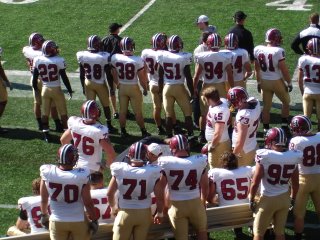
Fight fiercely, Harvard did. On the one hand, it must be easier to coach "smart" kids. On the other, their bodies can't always do what the coaches want them to do. Here's an example of a Harvard precept (the coach is the guy kneeling with the Harvard baseball cap on backwards, drawing up a formation):
While the line play interested my kids, they thought it was really nice of the Harvard kicker to serve the other player drinks. Cute observation, because on most football squads the kicker is lucky not to have the offensive linemen tape him to the goalposts after practice. I didn't tell the kids that, though. They might get the wrong impression about kickers, football and Ivy League football.
At any rate, the Tigers enjoyed a good first half after having their first punt blocked and seeing the Harvards score on the ensuing possession. After that, it was mostly Princeton, as the Tigers led 24-14 at the half and seemed in control of the contest. There was a controversial unsportsmanlike conduct call on the Tigers at the end of the first half that led to a Harvard score. My group was about as far away from the call as a fan could be at Princeton Stadium, so we chalked it up to overzealousness and a player one-upping an opponent about which school had the better genomics program. Getting the last word on boasting about tougher curricula is probably worth 15 yards if the punch line was good enough. Then again, from a football standpoint, that call helped give Harvard renewed life.
Harvard woke up after halftime. Perhaps the head coach chanted "Larry Summers" ten times to the left side of the defensive line and linebacking corps at halftime, or perhaps he appealed to their sense of scholarship by positing that the Princeton players felt superior because their school has taken steps against grade inflation while Harvard has not. Or perhaps he told them that their play resembled a bunch of Republican congressmen running from the press at the mention of former Congressman Foley's name more than an undefeated football team on a quest for a championship, but whatever the motivation, the Harvard eleven responded.
Two touchdowns later, is was 28-24, Harvard, and things looked bleak for Princeton. The Harvard QB looked like an upper Midwestern version of Donovan McNabb (this is a very loose analogy, because he ran well, but his physique more resembled that of College Physics Magazine's Hunk of the Year Contest winner than that of the Philadelphia Eagles' QB, who, at about 240 pounds, could fit in on the average Ivy line with little problem), dropping back and then running for first downs. The Princeton defense tried to contain him, and they had difficulty. Yet, during the day, they excelled at keeping their arms in their air trying to defend passes, and ultimately a few fell into the hands of Princeton's nickel back late in the game.
The Tigers marched downfield on the first of that future Wall Street star's picks, and an unsportsmanlike conduct penalty on one of Harvard's defensive backs helped the Tigers immeasurably. Whether the young man was flagged for boasting about Harvard's larger endowment is open for speculation, but the Tigers drew energy from the flag and scored what would prove to be the game-winning touchdown. Final score: Princeton 31, Harvard 28.
Yes, the Tigers are actually tied with Yale for first place in the Ivies. Here's proof:
And that's when the second pick happened, again by the same defensive back, and the Tigers ended up running out the clock.
Good food, good friends, good weather, the kids had fun, so what's more to ask on Homecoming, I ask?
Parking -- Free.
Pre-Game Party -- Free.
Tickets at the 40-yard line -- $4 apiece.
Programs -- Free.
Post-Game Party (with shrimp and oysters) -- Free.
Victory over Harvard at Homecoming and a fun outing with the family: Priceless.
Or, as they would chant in Tigertown:
Hip, hip, hip!
Rah, rah, rah!
Tiger, tiger, tiger!
Sis, sis, sis!
Boom, boom, boom!
Bah!
Tigers, Tigers, Tigers!
Sunday, October 22, 2006
And the Only Reason Billy King Keeps His Job As 76ers' GM Is. . .
that the 76ers are up for sale.
Think about it, the Flyers get off to an atrocious start this year. First, the cut three players, including a 15-year NHL veteran and a free agent they signed in the off-season to firm up their back line, and, then, they show long-time fan favorite and favorite of owner Ed Snider, Bob Clarke, their GM, the gate, along with well-respected coach Ken Hitchcock. Put simply, the Flyers were caught napping when the NHL changed the rules after the strike season and ended up with lummoxes when they needed cheetahs. Most teams figured out that the brawling, hit 'em with your big guys style that Ed Snider helped found in the mid-1970's finally became extinct.
Except for Snider and Clarke, and, well, the "owner" (Snider acts as owner but Comcast Corporation actually owns the team) doesn't get fired. It had to be hard for Snider, though, to see Clarke go, because Clarke is like a second son to him.
So why was the headline about the 76ers? Because Comcast owns them, too, and they've performed worse than the local hockey team over the past five seasons and Billy King still holds onto his job as GM. Funny thing was that King was once rumored to be a U.S. Senate candidate to face Republican Arlen Specter. That led to two thoughts -- 1) he could do less damage in the Senate than he could to the local hoops team and 2) what made anyone think he could do anything in the Senate since he's failed at helping run the local hoops team, Duke degree and Coach K connection (as well as Larry Brown connection) or not.
But Billy King remains, probably because the team is up for sale and won't make any changes until it is sold. Somehow, it strikes me that Billy King won't be the GM under the new ownership, and he may want to hook up with his fellow Duke alums Christian Laettner and Brian Davis and try for a second act with the Memphis Grizzlies.
At any rate, don't look for either the Flyers or the 76ers to improve quickly.
Thursday, October 19, 2006
Flag Football and Throwing a Football Around
My six year-old plays in a flag football league with a bunch of other first graders, and it's hilarious to watch. The kids wear colored jerseys and are named after college teams (and, yes, there is a Miami), and the jerseys are the size of hospital dressing growns for the big and tall set than rather particularly tailored to the skinny boys that tend to populate this game. The kids wear the jerseys, black pants and cleats, and they are required to don mouthgards (whether they can keep them in their mouths or not hold onto them while they play is another story).
And then there are the flags, which rest on either hip at the end of a belt contraption and which are the source of every defensive player's attention. Grab a flag, and you've "caught" or "stopped" your man. The kids line up with five kids on the line and two in the backfield. Most of the plays are running plays, some reverses, some misdirection, and an occasional passing play. Sometimes it looks like a fire drill, and at other times you get the one kid who is quicker than others, sometimes because he's spent a lot of his free time chasing after his older siblings. My kid's team has one of those kids, and every time he touches the ball he runs at least for half the field. And he's also the kid who makes most of the stops on defense.
My son likes to block, and the coaches tell the kids to hold their blocks. Sometimes the kids take their coaches too literally and simply hold, so instead of holding their blocks they are holding their opposite numbers. He likes to snap the ball and play quarterback, and he's had some keepers where he's scrambled into the secondary, if only to have the fastest kid on the other team get one of his flags right before he is able to break into daylight. He threw an incomplete pass and was lucky to escape the fate of one of his teammates, who threw an interception that, yes, the fastest kid on the other team -- and boy was this kid fast -- ran in for a score.
There's also the kicking game, and, no, they don't kick points after touchdown. Rather, they try two-point conversions, but they do kick off. When it was my son's turn, I figured that he would suffer the fate of his teammates by running up to the ball and then stopping his momentum (and torque) and then dribble the ball on the ground for about ten yards. But he didn't do that. Instead, he kept his momentum and hit a line drive that went about ten or more feet in the air and many yards downfield, well over the heads of the boys on the opposing team. I was amazed, agape.
So what happened?
The fastest kid on the other team scooped up the ball and made a beeline right up the middle of the field. In essence, my son outkicked his coverage -- on a kickoff. Fortunately, he had kept on running straight downfield and yanked the flag out of the kick returners belt, making the stop. So who said kickers aren't tough enough?
Amazed and agape, again. But very mellow in my celebration, of course.
Most parents are mellow, and the league has a code of conduct that prevents parents from doing anything other than encouraging the teams. Occasionally, there's a parent who's on the sidelines pacing, waiting to see his kid's talent emerge and break a run. I'm told that the parental interest (or is it interference?) increases markedly as the children age, but I doubt I'll be one of those parents (and I doubt my son will be one of those kids who will be a star running back at high school, but there are those who look like they could be on their way). Still, the kids are only six, and it will take many years for the talent to develop and, importantly, separate.
My wife isn't a huge football fan, and when she's gone to the games I've asked her for a report on what's happened, and she shrugs and smiles. "It's hard to say," she has offered on more than one occasion. "It looks like a bunch of kids running around, and it's hard to see what they're supposed to be doing." And then she adds, with a smile, "But it looks like they're having a lot of fun."
Which is the way it's supposed to be.
I don't know whether my son will continue playing flag football or will graduate to the Pop Warner's tackle division. He and I and my daughter (who's nine) love throwing a football around the yard, and my daughter has offered that she can throw a football better than any girl in her fourth-grade class (the gym teacher has taught them how to pass). After receiving some of her spirals last weekend, I can testify that she has quite a good arm and probably throws better than some of the boys (she wants to be a softball pitcher). And it's a really fun thing to do, tossing around a football, on a sunny weekend afternoon with no time constraints, laughing and pretending to be the favorite pro football player of the moment. We do it in the fall, we do it in the summer, and we look forward to do it on Thanksgiving. On that particular day, there's something very special, and we're thinking of talking with a bunch of families in the neighborhood to combine for a Thanksgiving morning touch football game.
That, too, should be a lot of fun.
To be clear, I am not sold on the overall football climate in this country, but when you individualize it and make it fun the way we have tried to, well, to a large extent that's what really should matter.
Just remember that when you send your six year-old to "go long", don't send him on a collision course with the mailbox.
John Chaney in Retirement
Mark Kram of The Philadelphia Daily News wrote an excellent article in today's paper about the retirement of former Temple basketball coach John Chaney. Coach Chaney sounds and looks very relaxed, and the stories that are related in the article are great. There's a particularly good one about a painting called "The Bench," that will make you laugh.
Wednesday, October 18, 2006
As We March Further Down the Road to Childhood Obesity
School districts are banning games of tag in the school yard.
Yikes!
Risk management rules again. It's better to avoid a tort risk than to create an environment where our kids can improve their physical fitness and avoid adding excess pounds. You can insure for the former, can't you, but not the latter? And, yes, kids can get hurt (doing anything), but shouldn't they be able to be kids and have free play? Does all play have to be programmed, like youth soccer?
How many rules can there be? How many rules should there be? Can't we just let kids be kids and run around and create their own games?
Enough is enough.
General Managers Gone Wild
Well, not exactly, and, certainly, not yet.
But because of the Yankees' crash in the post-season and the Mets' starting pitching problems (as evidenced by last night's loss) the post-season sweepstakes for starting pitching will be a feeding frenzy.
And this guy should get a ton of money, as it seems like the Yankees and Mets will have to pursue him. This guy should fare well, too (and likewise will draw interest from both of those teams). And the way he's pitched in the NLCS, Jeff Weaver, despite his spotty track record in recent seasons, could well get a Derek Lowe-like contract (you'll recall Lowe's heroics in the 2004 post-season after he was yanked from the BoSox rotation during the regular season).
The Mets have a frail Pedro Martinez, an ancient (if very gutsy) El Duque (who well could be in his forties), a soon-to-be-long-gone Steve Trachsel, an Old Master (who might not get the calls on the lines anymore) in Tom Glavine and an up-and-comer in John Maine. That's not exactly a starting pitching staff that makes people think "well, there's a strong chance of post-season success." It's relatively old, battered and tired.
The Yankees have Chien-Ming Wang, who is excellent, but they also have Randy Johnson, who's undergoing back surgery, who's old and who hasn't pitched well, Carl Pavano, who hasn't been healthy since he's been in NY and hasn't exactly wowed anyone with his judgment and Jaret Wright, on whom they've never been able to count. Cory Lidle, who just passed way, would have been a free agent, and Mike Mussina is a free agent and, from what I've gathered, unlikely to return (although I confess that I may be wrong about that). This, too, is not a pitching staff that makes one think that the Bronx Bombers are likely to make a deep run in the post-season. It's incomplete, inconsistent and injury-prone.
Oh, it's a fine time to be a free agent starting pitcher when both New York teams will be in the hunt, big-time, to fortify their staffs and are in need of at least two starting pitchers apiece.
Once the World Series is over and free-agent signing season begins, the hunt for big baseball game is on.
And the trophies are the guys who can pitch 200 innings and bring you 15 wins a season.
Omar Minaya has done a great job with the Mets, but the early line says that George Steinbrenner will get who he wants. Minaya, after all, hasn't been in Queens all that long, and he hasn't gone head-to-head with the Yankees.
It's the T-Rex versus the Raptor.
And it ought to be fun to watch.
Tuesday, October 17, 2006
I Know Sports Frog is Good, But. . .
I never knew how good. Gary Clark's update on the English Premiership is just first-rate.
And, yes, I'm playing ESPN's English Premiership Fantasy Soccer game. You get a budget, and you basically need to find guys who either can score or prevent the other team from scoring. One thing's certain -- take Thierry Henry, the Arsenal striker from France who just may be the best striker in the world.
And, yes, I'm playing ESPN's English Premiership Fantasy Soccer game. You get a budget, and you basically need to find guys who either can score or prevent the other team from scoring. One thing's certain -- take Thierry Henry, the Arsenal striker from France who just may be the best striker in the world.
Book Review: Michael Lewis's "The Blind Side"
Within the past couple of weeks, I read two excerpts from Michael Lewis's new book, one in the Sunday New York Times Magazine and one in Sports Illustrated. Both were excellent, and both compelled me to run out and buy "The Blind Side," which is Michael Lewis's new book regarding the evolution of the left tackle position in the National Football League. Lewis's last book, Moneyball, illustrated how a creative general manager, Oakland's Billy Beane, could field competitive teams by spending less and using statistics to find outstanding players measured in terms of metrics that not every team was willing to adopt.
The book hits the evolution of the position of left tackle from two distinct angles. One has Lewis address how the advent of the New York Giants' Lawrence Taylor in the early 1980's, and his team's deployment of the blitzing linebacker on a righthanded quarterback's blind side, had teams scrambling to figure out how to better protect their most prized player, the starting quarterback. (The advent of Chris Doleman, the quick and strong defensive end for the Vikings, contributed to the evolution too).
Before the advent of players like Taylor and Doleman, all offensive linemen were lumped together and paid similar sums. After the arrival of those players, teams had to find big and quick offensive linemen who could thwart those able players (such as Jonathan Ogden, Orlando Pace and William Roaf, among others). The left tackle, then, moved from being just another lummox-like offensive lineman to, in many cases, the second highest paid player on the team. Protecting the quarterback's blind side, to this day, is a key driver for all NFL coaches. Each year contenders turn into pretenders after they lose their starting quarterback to injury and the backup simply cannot run the offensive to playoff standards. That's why protecting the starter is so important, and that's why left tackle is such a prestigious position.
The book's second angle is much more compelling. It shows to what lengths colleges will go to lure the next best left tackle prospect to their school, and, more importantly, how a kid emerged from nowhere in Memphis (how this kid made it out of a horrible situation is a tribute to the kid himself and the people who took him into their lives and homes) to become the hottest left tackle prospect in the country a few years back. It's the tale of Michael Oher, now the starting left tackle at Ole Miss, and of the Tuohy family, which adopted him. (Lewis has a Tuohy connection -- he and Sean Tuohy, Michael Oher's adoptive father, grew up together in New Orleans). Oher, a very large and nimble teenager (nimble from spending the ages 10-15 doing not much more than playing basketball most of the day and showing two guard skills despite being about 6'5", 350), showed up at a private Memphis Christian high school as a tenth grader (age-wise; school-wise, he was at the elementary school level). Tuohy's daughter attended that school, and Leigh Anne Tuohy, Sean's wife, became a second mother to Michael Oher. Through Michael's persistence and the Tuohys' dedication, he made it through high school and became a legimitate Division I recruit.
The book makes interesting observations about college football coaches, high school coaches, and college football programs (I doubt that Lewis will be invited to Ole Miss anytime soon, as the book makes head coach Ed Orgeron sound like a semi-articulate cheerleader who is trying to mode a bunch of kids who probably don't belong taking a college curriculum into a national championship football team). And the book cogently points out how much many coaches (prominent among them Tennesssee's Phil Fulmer and then-LSU coach Nick Saban) wanted this amazingly athletic big kid to anchor their offensive lines for years to come -- all because he has an amazing athletic gift that will enable him to battle hard-charging right defensive ends for years to come.
Each story -- the analysis of the evolution of the left tackle position in the NFL and the Michael Oher story -- makes for good reading separately. Together, you get a great sense of not only the importance of the left tackle position, but how far and wide the "College Football Industrial Complex", as it were, will go in America to source the next great left tackle.
Read the whole thing -- it's another winner from a great writer.
Monday, October 16, 2006
I'm Getting Old (And Here's Why)
Everyone knows that if Game 5 of the NLCS wasn't rained out tonight, the Mets would have had to chose pitching the likes of Pee Wee Herman, Bud Melman, Hawthorne Wingo or Joe Klecko in Game 5. Yes, the Mets pitching is depleted.
So bad, in fact, that at Shea Stadium the other night a fan held up that said: "Glavine and Maine and Pray for Rain."
I didn't watch the broadcast (it was a school night) at the hour the sign was shown, but a colleague at work mentioned it and thought it was a very clever sign. She's not that much younger than me, but she thought that the idea was original.
And she was wrong.
Most fans under 40 would think that such a sign is one of the most clever baseball signs in a long time. The fact is that it derives from almost half a century ago, when the Milwaukee Braves featured two outstanding pitchers, future Hall of Famer Warren Spahn (the winningest lefty of all time) and Johnny Sain (who would go on to become a very good if controversial pitching coach, controversial because his popularity on his team frequently eclipsed that of the manager's). Unfortunately, the Braves, who featured, among others, players like Eddie Mathews and Hank Aaron, had little else in the way of starting pitching, so the saying, yes, was "Spahn and Sain and Pray for Rain."
So while the Met fan who created the sign tapped into a rich baseball legacy, he wasn't original. It's a shame, though, that today most fans wouldn't know about Spahn or Sain and the Braves' need for rain (a variant of the slogan was "Spahn and Sain and Two Day's Rain", because then pitching rotations contained only four pitchers).
The Mets got that rain tonight, and that gives the Ancient Met Tommy Glavine an extra day's rest and the Metropolitans a better chance to go back to Queens leading the Cardinals 3-2 in the NLCS. I am too young to have watched Spahn or Sain, and I don't know whether they ever got the rain they needed (perhaps in '57, but then, I believe, the Braves also had Lew Burdette on the roster), but Glavine and Maine did.
Pray for rain, indeed.
Sunday, October 15, 2006
PlayStation Review: FIFA Soccer 07
Why do I play this, you ask?
It goes something like this:
I, like most of the rest of you, have a job that is challenging and occassionally stressful and frustrating. It's a job where we talk about goals and objectives, and it's a job where sometimes you can lead a team to an outstanding result and sometimes when the moons aren't aligned it resembles a cat-herding exercise. It's an international job, too, so it helps to know international cultural aspects to let your colleagues know that you care about their culture. I don't know if the prior sentence logically followed the one that preceded it, but I write this to give a backdrop as to why I play this particular game.
First, the kids started playing soccer at the age of 3. They've since taken a break from it because the soccer locals are intense about it and are seeking commitments at ages before the talent truly separates that my "renaissance" kids (my joking term, not anyone else's) don't want to make and neither do we. Travel soccer at 7 1/2 seemed a bit much and also seemed predicated on a parent's willingness to drive as much as a kid's ability to play, and that, to me, is a mixed message. Kids on competitive teams should play because they're the best players, not because their parents can do the driving. Otherwise, it's tough to win if you can't put the best team out there all the time (that is, you have to play everyone because everyone has been willing to make the trip, and kids who travel will get discouraged if they join the team but don't get to play). Anyway, I wanted to learn more about soccer, so I took up this game several years ago, first playing FIFA Soccer 05.
Second, I wanted to learn the international game. It goes without saying that soccer is the most popular sport in the world, and I wanted to know who the key players are and what the key leagues are. With the World Cup coming up in '06, I wanted to get a sense of which countries were the countries to watch and who were the key players. Ultimately I learned about players like Zidane, Cannavaro, Buffon, Cech, Dida, Robinho, Ronaldinho, Henry, Owen, Rooney, Figo, Deco, etc.
Third, I wanted something to relax with at the end of the day. I quickly learned that I could score goals every day if I played the game at its lowest level ("Amateur") took a good team (such as Arsenal, Chelsea, Liverpool, Manchester United, AC Milan, Real Madrid, Juventus) against a bad one (such as Guegnon, Valenciennes, anyone in the English second division) and played at home. Initially I was winning 5-0, and then I started to win 8-0 or even once 11-0. How? I became adroit at dribbling, at passing, at handling the "set pieces" and at corner kicks. It was a great reward when I could center a ball from the wing and have an Henry or Rooney or von Nistelroy convert it into a goal. I don't get tired of the English announcer's exclaiming, "They just can't stop scoring." Occasionally I play the game in Spanish so I can hear the play-by-play announcer yell "Gooooooooooooooooooooooooooooooooool!" in a fashion that makes my son and I smile widely every time I hear it. That type of enthusiasm is infectious.
Anyway, the 05 game was fun, and the 06 version took some getting used to. The quality of the graphics was better, but you had to adjust to the game and think a few more split seconds ahead. The set pieces also got easier to calibrate, for in the 05 game despite the best of my trying I usually sailed a free kick so far over or beside the goal that it caused the broadcaster to say "they could have had a goal next to the goal and he still wouldn't have scored." Yes, the broadcasting was realistic and frank, even if the set pieces weren't.
The 06 improved the graphics and fixed the set pieces and seemed a marked improvement over the 05 game. Also, the referees were more wont to give red cards for initial egregious fouls in the 06 game than in the 05 game, and that has continued into the 07 game. Still, in games that feature, say, Chelsea hosting Scunthorpe or Swansea or Arrington, you aren't likely to have that many cards, because the players from Chelsea are so much better that they run laps around the players from an average Football League Two team.
The 07 game is an excellent game, with some of the improvements being that you can play the game from the vantage point of varying camera angles. I have chosen the "Dynamic" angle (resembling a realistic broadcast), changing the default from an overhead camera that seemed rooted in an old U.S. basketball arena than in a football stadium. The sun for the day games seems a little bit bright, and there's no option (as there was in 05) for playing on a rainy day (actually in 05 the rain was randomly generated -- you couldn't ask for it). The fields look more realistic, even with worn patches around the goals. You can play games in various famous international venues, but it was a bit disappointing not to be able to play Arsenal at Tottenham at Tottenham's home pitch (apparently the EA people can only tailor the game to so many different stadiums, so yesterday I played that match at London's Wembley Stadium; Arsenal's, Chelsea's and Manchester United's home pitches are featured). That's a minor knock, however, because you can pick teams from an increasing number of international leagues (last year they added the Polish league, this year the Turkish). The 07 game is an improvement over the 06 game, but not as big an improvement as the 06 game was over the 05 game.
Overall, FIFA Soccer remains a winner and is a fun way to play computer soccer and to learn who the players are on what team. There is one word of caution for beginners: be patient, as you have to learn all of the different buttons on the PlayStation controller and how they can work in combination with each other. It takes time. Dribbing comes easily, as does basic passing and shooting. But when you want to lob, hit a hard cross or get an extra boost on your first touch, well, you need to play the game for a while to learn the nuances. Give yourself a few months, and you'll be playing the game well.
That said, don't let this pastime detract from your day job. For me, it's a good occasional diversion when I need to wind down.
After all, it's fun to achieve goals, and it's fun to score them too.
A Hockey Game Broke Out in Miami Last Night
Read this and see what I mean.
I watched footage of the Miami-Florida International game last night and wasn't surprised to see that 8 FIU players were kicked out of the contest after a donneybrook ensued at the end of an extra-point conversion or that 5 Miami players were ejected. What did surprise me was that the Miami player wielding the helmet (and, by the way, why would anyone wander into a fight among huge football players and NOT have his helmet on?) and the Miami player who was trying out his stomping techniques were not among those ejected. My guess is that the ACC commissioner and the NCAA will weigh in and make those two student-athletes miss several games and contemplate how best to handle their anger.
It was an awful display.
It also makes you wonder about the future of Miami football coach, Larry Coker, about whom I blogged earlier this season when he issued a statement discouraging his players from owning guns. Makes you wonder whether Coach Coker has control of his own team.
Okay, boys can be boys and bad things can happen (if you think I buy those arguments, you're dead wrong), but I recall Michael Irvin's comments a couple of years ago after the awful incident involving several Indiana Pacers' players who went into the stands in Detroit and battled fans. When one of his co-commentators on an ESPN show said that fans can say terrible things, Irvin replied: "How can you let anyone have that much power over you to cause yourself to do something so stupid?" Or something to that effect.
It was a great point.
I don't know who started it and who thought who was defending whom, but stomping and helmet-swinging have no part of a college football game. Nor do rugby scrums where players are simply teeing off on one another. It was an embarrassing moment for college football last night, and perhaps those with power over their own teams will mete out a punishment that serves as a significant deterrent for years to come.
That it involved Miami is significant too, and the episode reminds me of that conversation I had with my dad about the high school teacher who kept on missing time because she had four car accidents over a two-year period.
"Son, if you have one accident, it's probably an accident. If you have four accidents over that period of time, you probably have a driving problem."
Miami might have that type of problem. The recruitment of Willie Williams, players defending themselves with guns, and now this.
And it says here that Larry Coker, who was on the ropes, doesn't coach at Miami after this year.
Saturday, October 14, 2006
Hold Those Tigers!
The Detroit Tigers aren't the only hot Tigers in the U.S.
The Princeton Tigers are 5-0, 2-0 in the Ivies and off to their best start since 1995. They beat a good Brown team last night, 17-3, in Princeton and have a defense that could well win a title.
Next weekend's game against archrival Harvard could pack Princeton Stadium for the first time since its inception.
Could it be that the Tigers have another title in them? Where's Penn? Where are Yale and Harvard?
The season is only half over, and the Tigers still have some serious work to do.
Thursday, October 12, 2006
Tuesday, October 10, 2006
The Yankees
Okay, so I'm a bit late, but I wanted to gather my thoughts. Here they are:
1. I respect George Steinbrenner, Joe Torre, most of the players and the Yankee tradition. It's the Yankee fans that can drive you nuts, personified by New York sports talk show host Mike Francesa of "Mike and the Mad Dog" on WFAN in NYC. His calling the Yankees "the varsity" and implying that everyone else is lucky to be in a league with them have always been a bit much. Memo to Mike: Where the *@^&%$ has the varsity been for the past five years?
2. Was A-Rod really the problem, or basically the lightning rod for a concept that friends at work referenced (and which they heard on the fan): "The roster designed to draw 4 million fans isn't necessarily the roster destined to win a World Series." Put differently, where's the Tom Lawless, the Bernie Carbo, the John Lowenstein? Nowhere to be found, that is. Hard to have great chemistry in that clubhouse with a bunch of high-salaried players wanting, or used to, marquis idol status.
3. What happened to the great Yankee bullpens? The better bullpen in NYC (and best in the Majors) is across town, and Mariano Rivera is at the end of a brilliant career and has an iffy wing. He wouldn't have been able to pitch more than 1 inning a game, and the set-up guys aren't nearly as good as when they had Jeff Nelson and Mike Stanton. If a starter goes 6 innings, who gets the starter to Mariano?
4. What will the Bombers do for starting pitching next year? Randy Johnson needs too many joint transplants to make a meaningful contribution, and it's doubtful the Yankees will exercise the club option on Mike Mussina, who can still pitch. Chien-Ming Wang is very good, but who will join him? Carl Pavano? Jaret Wright? With the questionable bullpen and a depleted starting rotation (and outside Barry Zito, not much out there in free agency to help), the Yankees could drop behind both Boston and Toronto in the NL East.
5. Will the Yankees move A-Rod? Rumors have been flying about A-Rod's future, especially with the return of Joe Torre, so the off-season in the Bronx should be interesting to say the least.
6. Does the Varsity have one more World Series in it with Jeter captaining the team? Derek Jeter is a great player, a Hall of Famer, but the lineup didn't come through in the clutch, the team is aging (two seasons ago it was the oldest lineup in baseball, and now it has to be close), and I think that the odds are against it. It seems that you need a mix of young, mid-career and old players, thoroughbred starting pitchers, crafty veterans, long men in the bullpen having career years and a closer who is at the top of his game. That's not the Yankee roster, and it's hard to build chemistry when each of your starting position players has made an All-Star team but your bullpen is populated with people who are not comparable in ability.
7. As for Yankee fans, be patient and be thankful you have an owner who will try to do everything it takes to win a World Series. Most cities don't have that type of owner, and you should hope that when the Boss is gone, those who succeed him feel as compelled to win as he has felt.
Bottom line: The Yankees will somehow be in the hunt next year.
Even if their payroll approaches $250 million.
"Excellence," a one-time Nobel prize winner once said, "cannot be bought. But it must be paid for."
For the Bronx Bombers, that's an interesting thought. Paid for how? Through patience? Through developing pitchers? Through developing position players? Through realizing that you don't have to have $10 million plus players at each position and that it could be okay to have a Jeff Conine, a Jamie Moyer on your bench?
The off-season, and the hot stove model that comes with it, will be very compelling indeed.
Friday, October 06, 2006
Feel Good Story of the Year
Read this -- you won't be sorry.
It's the story of the journey of Chris Coste, the 33 year-old rookie catcher with the Phillies who had a remarkable year for the club. It's the story of a guy who's traveled a lot, who bided his time, and who made the most of his opportunity.
The Philadelphia Eagles gave us Vince Papale.
The Philadelphia Phillies have given us Chris Coste.
His is a wonderful story.
Sunday, October 01, 2006
How to Protect Ryan Howard in the Lineup
Now that the Phillies have been eliminated, it's probably the most compelling question for GM Pat Gillick to answer. Yes, there are tons of roster questions, but during the month of September (and the Phils and Astros have the best records in baseball in September over the past two years; too bad for the Phillies that their July was so putrid) it became clear to opposing managers that if they intentionally walked Ryan Howard or pitched around him (giving him little to hit, which meant either that they would walk him by nibbling at the corners), the Phillies didn't have much behind him to create runs.
David Dellucci, who played well in a part-time role when he and Shane Victorino were the fourth and fifth outfielders earlier in the season, failed in his platoon with Jeff Conine, who was acquired for the stretch run.
Conine hit reasonably well average-wise, but showed little pop.
Pat Burrell's season, and perhaps career in Philadelphia, fell off the table.
Chris Coste wasn't a consideration, but he might have been a better option than the other three. Still, a 33 year-old rookie having one magical season is probably not the long-term solution to protect Ryan Howard in the lineup.
Of the current roster, a suggestion was made to move Chase Utley to fifth to protect Howard. Aaron Rowand, interviewed on a local talk radio station, said he had thought about his team's putting Utley behind Howard, but, if they were to do so, he would move Howard to third in the lineup and Utley to fourth. Still, that's a risky proposition, because Utley's speed would be taken away and because the front four of the lineup -- SS Jimmy Rollins (who showed amazing power in the second half of the season; he and Utley were only the third 2B-SS combination in baseball history to each hit over 25 HRs -- the other 2 were Vern Stephens and Bobby Doerr of the Red Sox, who did it twice over fifty years ago), CF Shane Victorino, Utley and Howard.
So, instead of tinkering with the current first four, GM Pat Gillick probably will hit the free agent market looking for a big bat. The problem is, there aren't any, really, for two reasons. First, the pickings are slim, which means that those bats who might be available (such as Giants 3B Pedro Feliz) probably will be offered more than they're worth. Second, the Phillies have payroll issues. Ownership is still paying off part of Jim Thome's contract, and they'll probably have to agree to eat a bunch of Pat Burrell's should the team get the OF to waive his no-trade contract and send him away. Atop that, ownership needs to find a way to lock up Utley and Howard to longer-term deals, the way the Mets did with SS Jose Reyes and 3B David Wright. Management can't use the Thome and Burrell situations as an excuse not to offer more money and security to Utley and Howard -- it wasn't the players fault that ownership had made those decisions. And it doesn't look like they're going to lock up Utley and Howard now.
There could be, though, one solution, controversial, perhaps cost-effective, that Pat Gillick might be willing to go for. It's creative, it's explosive, it's risky, but it might not be as expensive as you think.
His name is Barry Bonds.
Loyal blog readers know that I am no huge Bonds fan, and that my detractions come not from his efforts on the playing field, but from his persona off it and, yes, some of the life choices he's made in furthering his career. I can't say right now that I endorse what I'm about to suggest (which is more in the way of a prognostication or speculation), but it just might make sense for the Phillies.
Here's why:
1. Bonds missed most of the '05 season and was iffy in the '06 season. He did show signs of improvement at the end of '06, and he might have another season or two left in him where he could put up good numbers.
2. Bonds wants the home run record.
3. Citizens Bank Park is a home run hitters' park. SBC Park in SF is a pitchers' park. The chances for Barry Bonds to hit more home runs more quickly is tempting.
4. Bonds is a #5 hitter now. Have him and Utley sandwich Howard, and, well, all of them will get tons of pitches to hit. The prospects are frightening.
5. Bonds' physique should be better in '07, as '06 seemed to be a healing year for him.
6. He might come more cheaply than his current contract. He's controversial, he's at the end of his career, and he might sign a 1-year deal for $10 million.
7. He seemed to have bonded with Ryan Howard at the All-Star Game.
Here's why not:
1. He's old, not fully healthy, and not a long-term solution. If the Phillies can find a longer-term solution, they probably will.
2. He'd be a liability in the field now; he's more suited to being a designated hitter somewhere in the AL.
3. The Phillies demonstrated great chemistry in the clubhouse after the July 31 trading deadline. Why bring this guy in to challenge that chemistry -- you know he will.
4. The Phillies don't need him for attendance purposes. He was roundly booed in May when the Giants were in town, and the fans, who showed the team a lot of love during the playoff drive, will be confused and/or upset at the move. That said, if the team gets him and he says the right things and gets off to a good start, they could embrace him. However, given the city's experience with Terrell Owens, the fans might not give Bonds a chance. Once burned, these folks not only will be shy, they could be derisive at the start.
5. The whole BALCO/steroids mess (which, by the way, is perhaps #1 in the way of priority). Bonds is radioactive -- he could help big-time or he could turn into baseball's version of Three Mile Island. That's a huge risk in and of itself.
6. Putting Bonds behind Utley and Howard would give the Phillies' three lefty bats in the heart of the order. Yes, pity the teams whose starting rotations are laden with righties, but you can imagine that most managers would try to manipulate their rotations to throw as many lefties as possible against the Phillies. That's not to say that these guys can't hit lefties -- they can -- but lefties are, well, lefties, and their craftiness can cause even this Murderer's Row to flail and dying-quail breaking pitches in the August heat.
7. Bonds isn't an everyday player anymore. You'd still need someone to platoon with him; that might be Jeff Conine anyway.
So what's the verdict?
Signing Bonds would look more like a last-ditch, stop-gap measure than a well thought out move of a savvy, seasoned GM who is looking to build a better team for '07 and beyond. While Bonds could solve an immediate problem, he could create many more. His availability is tempting, but given the way Gillick shaped the Phillies into a contender this fall (after the July 31 deadline he opined that the team might not contend until 2008), he probably has enough moves up his sleeve to improve the roster without pulling the national pastime equivalent of driving to Atlantic City and putting all of his pre-2007 moves on red.
Yesterday the Phillies were knocked out of playoff contention.
Today it's raining hard in the Philadelphia area.
It was fun turning on the hot stove, at least for the moment.
Friday, September 29, 2006
Old Tickets, Long Rain Delays and the Ghosts of 1964
Gloomy night in the mid-Atlantic region last night, the day that my dad would have turned 77 were he still with us. The Phillies ended up being engulfed in the longest rain delay in MLB history, only to fall to the Nats, 3-1 and fall two games out of the Wild Card with 3 to play. Phillies' fans are hoping that the echoes of Willie Mays, Willie McCovey and yes, Joe Morgan (whose last-day HR in the fall of '82 while a Giant knocked the Dodgers out of the NL West lead and enabled the Astros to win the division) inspire Barry Bonds & Co. to take three straight from the visitors from L.A.
The Phils, meanwhile, travel to Florida to play a pumped-up Marlins' squad, two of whose players, Scott Olsen and Taylor Tankersley, provided bulletin-board material for the Phillies in this morning's newspapers. Apparently when your team's payroll has defined the new term "Loria Line", the payroll equivalent to hitting's Mendoza Line, there is no room in the budget for a Dale Carnegie course for brash rookies playing in one of baseball's circles of hell.
In St. Louis, the Astros have gained 8 games on the Cardinals in the past 3 weeks, summoning up bad memories for those in Philadelphia 50 or over who remember the collapse of the '64 team, which was 6 1/2 up with 12 games to play, only to end up in third place in the National League. Will the Cardinals hold on, or will Tony LaRussa get paired with Gene Mauch in post-mortem discussions about what went wrong with the Cards' season. Even the St. Louis headline writers are acting like they worked for The Philadelphia Daily News in 1964, calling last night's effort against the Brewers "half-hearted." Perhaps it's the Philadelphia writers who get the bad rap. At any rate, all eyes will be on the Cardinals -- and the Astros.
So what do do during a rain delay? After playing a game of Strat-o-Matic with my son (Brett Myers bested Bronson Arroyo, and Kenny Lofton got four hits in four at-bats -- we played the '05 season as, of course, the '06 game cards won't be out until March of '07), we watched a videotape of the 1980 World Series, the one and only time the Phillies won a World Series. One thing we noticed was how thing the players were, especially Bake McBride and Gary Maddox. Now, in fairness, people are generally heavier today, and there wasn't the weight training then that the players do today. There also weren't all of the supplements that are lying around, including, of course, the banned ones. We also saw great hitting by Willie Mays Aikens, Amos Otis, Willie Wilson and Mike Schmidt, as well as a great throw by Manny Trillo and some heartrate-increasing pitching by Tug McGraw. And, yes, there was Pete Rose's great "save" of a dropped foul pop-up by Bob Boone that signaled to Phillies' fans that for once the stars were aligned and that the hometown nine was going to win a World Series.
During the rain delay, we watched the "Return to Glory" episode that featured the Dodgers' improbable 1988 World Series victory of the Oakland A's, and that also featured Kirk Gibson's memorable game-winning HR in Game 1, when the rugged OF limped to the plate because of injured knees. One thing that was apparent that this Series was played before Jose Canseco and Mark McGwire discovered the weight room, GNC stores or poorly lit parking lots of local gyms and the people who hung out there. Back in that day, not every baseball player was built like he could catch a swing pass, lower a shoulder and knock out the LB trying to take his head off. Not that every baseball player today looks that way, either, but the comparisons are striking.
The rain delay continued, and I brought out an old lucite cookie jar in which I store my old tickets from sporting events. I know, they should be in lucite or lying flat, but there is only so much stuff you can keep. I found my father's ticket to Game 6 of the 1980 Series, the final game, and the face value was only $15.00. I found tickets from the 1983 World Series (where the Phillies lost to the Orioles) and the 1993 World Series (where the Blue Jays beat the Phillies). I found my ticket to Game 6 of the 1974 Stanley Cup Finals, where the Flyers beat the Bruins 1-0 after Kate Smith sang the national anthem. Through a bizarre set of circumstances, an acquaintance of my father's couldn't go to the game, and we sat in the fifth row behind the benches at center ice. After the Flyers won and started celebrating, I ran up to the benches looking for a souvenir. I took a water bottle from the benches. I still have it -- it's at my mother's house, but, of course, I doubt today anyone will believe what that was or where I got it. There's just no way to authenticate stuff like that. It was an energizing time nonetheless.
There were tons of Phillies tickets, some of which had a face value of $5 or less. I couldn't remember whether I had the tickets from August 1990, when I was in Europe on a business trip. The significance of that was that I had planned to go to a Phillies' game that week, and it turned out that Terry Mulholland pitched the only no-hitter in Veterans Stadium history on the night I was supposed to go to the game. There were Dodgers' tickets, Giants' tickets and A's tickets from my days of living in California, and various college football and basketball tickets. I shared them with my kids, who couldn't believe at how inexpensive some of those tickets were relative to what we pay today. It was a great trip down memory lane on a day when I remembered my father, who, would have been 77, still would have found ways to take my kids to games and would have loaded up their rooms with all sorts of goodies. If there's one solace that I can take from his too-early passing (he died 20 years ago), it is that the kids are endowed with his spirit and sense of joy about their games -- both playing and watching.
I miss him, especially at times when the Phillies are doing well, which remain far too few. We shared the watershed days of the late 1970's and early 1980's, and I look back thankfully to the Sunday plan that he purchased and our trips to Veterans Stadium where it was hot as can be and where there was a giveaway and Steve Carlton ended up pitching on Sundays before 45,000 more often than not. I remember how we left home after an early lunch for a 1:05 game, only to return home slightly after 3 with my mother asking what happened. The answer was simple and funny -- Carlton had hooked up in a classic pitcher's duel against the Padres' Randy Jones, who, for two years in the mid-1970's pitched like the great lefties of all-time -- Koufax, Spahn and Grove -- and the Phils won 1-0 in a game that took only 1:30 to play. Sure, the Vet isn't Wrigley or Fenway, but your hometown park is a magical one when you're a kid, and, when your team is winning, it's heaven on earth, your secular temple.
The tickets were a trip back in time for me. I haven't matched them up on the internet with actual games, but at some point -- perhaps during the next big snowstorm in the winter -- I'll do that. Normally I don't like rain delays, but what filled last night's up was a link between generations -- what I had with my father and what I'd like to accomplish with my own children. Seeing them laugh at Bake McBride's hair or Larry Bowa's bouncing after McGraw struck out Wilson to clinch the World Series, having them marvel at the World Series tickets, sharing chuckles at some of the outfits people were wearing, even in 1980, was much fun. I hope to be around them for a long time, and I hope that I am honoring my father's memory by starting them on the road to a good number of shared experiences that they'll reflect back upon happily decades down the road, just the way we did last night.
Yes, our favorite team lost (the game began at 11:37, and I was fast asleep by the time it started), and, yes, they're probably going to miss out on wild card birth narrowly for the second year in a row (sorry, but the realistic Phillies' fan must take over now -- it's a time-honed defense mechanism). But the compelling thing about the national pastime is sharing it with your family and friends.
Even in a rain delay.
Especially in a rain delay.
Thursday, September 28, 2006
How About This for a Baseball Statistic?
I'm reading Baseball Prospectus's book "Baseball Between the Numbers", and I'm getting dizzy with all of the fact and figures that are out there surrounding baseball. Given bio-engineering and performance enhancing drugs (read: Victor Conte meets "The Six Million Dollar Man"), I wonder if we're about a century away from some type of pseudo-droid whose performance will be relatively predictable if he gets the right type of medical devices, legalized medicine and macrobiotic food. That's why I always liked the Jim Leyritz's of the world, guys who come up big in the clutch but whom you wouldn't recognize in the Saturday morning line at your local post office. To me, there's some element of the game that refuses to let the numbers guys predict everything. Chris Coste of the Phillies is proof of that.
Still, the numbers in baseball are more compelling than in any other sport, and baseball fans live for them. Most still focus on batting average, home runs and RBIs, as well as runs scored and total hits. Look at the Sunday papers, and they'll give you the cumulative hitting stats by league, where players are ranked by batting average and then you also see their home runs and RBIs. Forget about on-base percentage, forget about slugging percentage, and forget about OPS, which adds the former two. They don't appear in Sunday papers, and they don't even appear in my fantasy league (which really makes it a true fantasy league).
So, while we're at talking numbers, here's a stat that I think is a measure of a hitter's productivity (an analogous one could be calculated for pitchers, but I haven't gotten there yet). Let's called it TBP -- Total Bases Produced, and it's a ratio whose numerator is total bases plus walks plus hit-by-pitches plus net steals (steals minus the number of times caught stealing) over total plate appearances (at-bats plus walks plus hit-by-pitches). To me, unless I am missing something, this talks about how many bases a batter produces per at-bat.
Follow me so far?
If you go to ESPN's statistics for each team, they provide enough detail that you can calculate this yourself. I did it three days ago for four Phillies and four Mets -- Ryan Howard, Chase Utley, Jimmy Rollins and Pat Burrell for the Phillies and David Wright, Jose Reyes, Carlos Beltran and Carlos Delgado for the Mets. Please bear with me here, because unfortunately the time that I have to write doesn't coincide with the time I have to hunt for my back-of-the-envelope calculations (which I misplaced), so I'm writing from memory here. Going into Tuesday night's games, Messrs. Rollins, Utley and Burrell had TBP's ranging from about .565 to .585. Messrs. Wright, Reyes, Beltran and Delgado had TBP's ranging from about .570 to about .605 (I confess that Beltran's might be a bit higher).
Ryan Howard?
A TBP of about 0.72.
Albert Pujols is in the same rarified air, slightly higher than 0.72.
Okay, so most baseball watchers had already narrowed down the MVP race to Pujols and Howard.
This number tells you why. These guys produce more bases per plate appearance than any other players.
And that's probably enough to win the MVP race.
A week ago I would have said that the MVP race was Howard's, hands down. This morning I'm not so sure. If the Cardinals blow the NL Central, then Howard will win the MVP award. However, if the Phillies don't win the Wild Card and if the Cardinals preserve their lead and Pujols plays a key role (his 3-run shot last night won the game for the Redbirds), then he will win the honor.
Total Bases Per Plate Appearance -- Get your calculators out today!
All Hands on Deck
The Phillies beat the Nationals last night, 8-7, in 14 innings to keep their Wild Card hopes alive. They trail the Dodgers by 1 game.
I listened to the game when they were down 4-3 and watched it from the 7th on after they took a 5-4 lead, only to have the Nats come back and tie it in the 9th and 10th. It was a flat-out great baseball game, and you wouldn't have known that the Nats are out of contention or that manager Frank Robinson is in danger of losing his job from the way the home team played last night.
It was a night where both closers pitched badly, Tom Gordon for the Phils (who threw twice as many balls as strikes) and Chad Cordero for the Nats. It was a night where Ryan Howard was walked intentionally 3 times late in the game, only to see the guy hitting behind him, Jeff Conine, go 0-7 for the game. It was a night where of the 25,000 in attendance at the game's beginning, those who were there at the end favored the Phillies and were most vocal about it. It was also a night where bunting was paramount (Nook Logan for the Nats and Michael Bourn for the Phillies), where the Made-for-Disney career minor leaguer (Chris Coste) kept on getting hit after hit late in the game, and where a career AAAA player (Clay Condrey) pitched outstanding relief for the victors while one of the last men standing in the Phillies' bullpen, Rule 5 pick Fabio Castro (who usually only pitches when the team is about to ten-run rule the opponent), got an iffy save thanks to a great turn of a double play by Chase Utley and Rollins in the bottom of the 14th.
The managers combined to make more moves than Bobby Fischer did against Boris Spassky in Rejkjavik over thirty years ago. 47 players made their way into a contest that lasted almost 5 hours. The Dodgers' game in Colorado, which started about one and a half hours later, ended before the Phillies-Nationals contest did. My guess is that the Dodgers' players were a little delayed in leaving the clubhouse, prone in all likelihood to watch the end of the game at RFK Stadium to see whether they'd have a one- or two-game lead after the night ended.
Frank Robinson managed as though it were his team who was desperate to grab the Wild Card berth, and his players reflected his intensity. In the end, it was Jimmy Rollins' two-run triple in the top of the 14th that proved too much for the gritty Nats. Somehow, Fabio Castro had enough to preserve the Phillies' lead (and avoid a third blown save in the game for the visitors).
It was a great game.
Kudos to the diehard Phillies' fans that made their way to DC and proved to be a vocal presence for their beloved team. I do agree with Jimmy Rollins, though, in that the fans should lay off Pat Burrell, who has had a woeful September and has probably played his way out of Philadelphia, even if the Phillies will have to pay the Pirates, Expos or any other MLB equivalent of a certified diamond landfill to take him off their hands. Look, Burrell is trying, and he doesn't want to hit majestic pop-ups or strike out with the frequency that he has in September. On the very bright side for an acquirer, he has a good on-base percentage and an excellent ratio of total bases plus walks and net steals over total plate appearances, right up there with his more heralded teammates Chase Utley and Jimmy Rollins (Ryan Howard is a galaxy of his own with this statistic). It sends the team a weird message -- you're manic about their prospects but very down on one of their own. My request -- be kind here, show magnanimity and cheer everyone.
They deserve it.
Wednesday, September 27, 2006
Should Baseball Have Instant Replay?
I don't know how it would work and under what circumstances it could be used, but the Phillies (and, yes, I bleed for them) lost last night because the umpiring crew blew a call which they acknowledged that they blew.
In the second inning, with 2 men on base, Chase Utley hit a very long humpbacked line drive that made a beeline for the rightfield foul pole. Utley later said he lost the shot in the lights, but at the time the umpiring crew ruled the shot a foul ball, and no one from the Phillies' bench protested the call. All the while, the Phillies' broadcast crew watched an instant replay, and it was clear that the ball hit the foul pole (perhaps a few feet above the right field fence) and was a home run.
The Nationals beat the Phillies, 4-3.
Now I'm not going to argue that this blown call could cost the Phillies a season. Sure, it might have cost them last night's game, but the Phillies left a bunch of men on base, and Pat Burrell looked lost out there. As for the season, the Phils lost something like 25 of 31 in the heart of the summer, at a time when they had Ryan Madson and Gavin Floyd in the starting rotation, both of whom they stayed with too long. It wasn't until after the July 31 trading deadline that the team came to life, and it came to life once those who remained could relax because they weren't on the trading block any more. Presto, magico, and the Phillies, who have one of the two best records in September over the past two seasons, turned into a wild card contender.
All that said, the call last night was bad, and it does bear on the season. Isn't there anything Major League Baseball can do to correct obvious errors like this? Shouldn't the umpires' crew chief be able to check a TV monitor on long fouls that come close to the foul pole? Is there any harm in that?
No, I don't want NFL-like instant replay, and, of course, there is no way to penalize a baseball team with a timeout the way you can in the NFL if a team challenges a call. Still, in the past two weeks, the Phillies have lost two home runs (Ryan Howard's was the other) because the umpires weren't in position to make the call. That's not right, and something should change.
And, yes, I would say this if the Nationals or Padres or Dodgers were on the losing end of these decisions.
Apparently the umpiring crew from last night's game told a Comcast reporter that they felt terribly that they missed the call. It's good that they could admit the transgression, and I'm sure that the umpires will learn from the experience. Chast Utley was gracious after last night's game, saying that the umpires are human, and everyone makes mistakes (he booted a grounder last night that enabled the game-deciding run to score).
Lots of grace, lots of contrition.
But going into tonight's game, the Phillies are trailing the Dodgers by 1 in the Wild Card chase.
And they shouldn't be.
Friday, September 22, 2006
Compelling Unsuccessful Owners to Sell a Team
Bear with me here.
Suppose you live in a town where your team has lost more than it's won for more than ten years in a row. Suppose that during this time the same ownership group has owned the team for seven years. It's a fact that the four major sports leagues have a monopoly on the sport in your town. In any other business, if you have seven bad years in a row you're probably out of business and the management team is gone, most likely long gone. In baseball, basketball, football and hockey that doesn't happen.
Al Davis continues to run the Oakland Raiders into the ground.
The Pirates have had, what, 14 straight losing seasons (and the same ownership group has owned them for more than five years, I believe).
David Glass hasn't done anything to help the Kansas City Royals' fortunes.
Up until recently, Donald Sterling made the L.A. Clippers the laughingstock of the National Basketball Association.
I'm sure that there are other examples.
The point is that the local fans are stuck. There was a great debate last week on ESPN Radio about the walkout that 1000 fans staged at Camden Yards last week to protest Peter Angelos' ownership of the Baltimore Orioles. If you know anything about Baltimore, you know it's a great baseball town. Its stadium is terrific, and its history from the 60's to the 80's was rich. Since the late 1980's, though, Baltimore fans haven't had much to cheer about.
So the fans staged their walkout. Peter Angelos, a pugnacious lawyer (and, no, that's not redundant), chastised them for their behavior, claiming that they didn't know what they were talking about and that they were dissing the players on the field (query whether, if asked privately, the players would have agreed with them about Angelos' ownership of the team). The bottom line, as Angelos should know, is that the figures don't lie. The great thing about sports is that the won-lost record is the final metric as to whether you've had a good season. And how many consecutive losing seasons have the Orioles had? Nine, to be exact.
Mike Greenberg thought the gesture was eloquent, but in the end he agreed with Mike Golic that the walkout would have no effect. The fans really aren't going to turn their backs on baseball. Sure, some will, as there are many who won't support a perpetual loser. Fair enough. But for the rest of us who don't want to throw out the experience of sharing a great game through the generations of our families, we're stuck. Sure, we could switch allegiance to an out-of-town team, but it's not easy to travel hundreds of miles to a game and it's not a guarantee that you'll be able to get tickets. Put simply, you're stuck with the bad ownership for as long as they decide to own the team. You'll go to the games because you like the sport and because the opposing team might have some good players, but you're experience will be a relatively numb one.
And that's just plain unfair. I won't argue the merits of whether pro sports are a "business" according to the U.S. Supreme Court and, as a result, deserve the protections they get as monopolies, but I will argue to the Lords of Sports the point of fundamental fairness -- it just isn't fair to Royals' fans or Raiders' fans or even Phillies' fans (the last 2 seasons and 1993 notwithstanding, as the past 22 years under the current ownership has been a painful experience for the most part) that they have to suffer with unsuccessful ownership for years on end. The fans should have some say, shouldn't they? Or, if they shouldn't have those rights, shouldn't the sport as a whole have some say so as to police its trademark and the quality of the game? Shouldn't they say to Kansas City, "hey, you've had your shot, ownership, but now it's time to sell the team. Auction it off, get New York investment bankers in a bidding war for a new toy, sell it for hundreds of millions, but sell it and let someone else try to run the team. Someone who, as a qualified bidder, will agree to increase the team's payroll well past the Florida Marlins' "Loria" line of $15 million to the average of the league within three years of owning the team. Someone who will have to sell the team if they don't have a certain amount of winning seasons over a certain period of time.
That rule, in and of itself, will make all pro sports leagues more competitive and give the loyal fans in some towns with historical doormats some hope. Royals' fans who so loyally supported George Brett and Company deserve better, as do Raiders' fans who recall a time when no one wanted to face Ken Stabler, Art Shell and Gene Upshaw. Pirates' fans deserve a return to the days of Pops Stargell and Dave Parker at some point, don't they? The pro leagues all have their pockets of perennial losers. And, yes, now the Baltimore Orioles fit that bill.
Sorry, Mr. Angelos, but your team has had nine losing seasons in a row. Clearly, the genius you have shown in winning lawsuits has not translated to the baseball diamond. There's no great shame in that. You entered the arena, did the best you think you could have, but you did not succeed. Many don't. But unlike the real world, where businesses that can't turn a profit end up getting acquired or shuttered, you can continue on with your exclusive license, charge more than five bucks for a beer and throw out a pitching staff more ready for a beer league than the Major Leagues.
And get away with it.
That's just not right.
The fans of Baltimore, Oakland, Kansas City and all of professional sports deserve better. All organized leagues should adopt a "call" rule that enables them to require a franchise's ownership group to put the team up for sale if minimum requirements for success are not met. America is the great meritocracy, so if these are our great American games, they have to compete on a fair business playing field that enables the consumer to have a chance at seeing a winner. Putting in this "call" rule will ensure loyal fans that they will actually have a chance to root for a winner.
Is there anything wrong with that?
There are little boys and girls in Pittsburgh, Baltimore and Kansas City who have grown up and are growing up watching bad teams. Don't try to buy them off with the fact that at least they get to see the Yankees, Red Sox, Braves, A's, etc. come to town, and they should be satisfied with that. Who is satisfied with that? Who likes rooting for a team with no hope? It's just not right.
I watch my local team, the Phillies, with excitement these days. Last night they lost a compelling game to the Astros, a game between two teams fighting for playoff spots. There was a sellout crowd, and the fans hung on every pitch. The hometown nine lost, but the game was a great one. It was a great feeling to be able to watch a game that meant something on September 25 for only the second time in the past 20 years (and the second time in the past two years). Too infrequent, of course, but fun last night (and, yes, I still believe that the best thing the current ownership group could do is sell the team, because they would have been out of business and jobs years ago if the market in which they compete is truly competitive). Everyone should have that feeling -- or at least the chance to have that feeling.
Walkouts like the one the Orioles' fans staged are noble but won't achieve the goal of having current ownership sell the team. But they should send a message to professional sports leagues that they should not tolerate bad ownership groups who are not committed to fielding winners.
It's time for a change.
Sunday, September 17, 2006
Finishing
I don't recall when I first heard this term used in sports, although it might have been used in conjunction with Chris Webber's role on Michigan's "Fab Five" teams in the 90's. Webber isn't a great shooter, but he had a knack of getting inside and making a lot of baskets in traffic. It also seemed like he could follow others' shots and convert offensive rebounds into scores. The Fab Five rolled over most of its competition, and they had a good knack of finishing off opponents. Put differently, when they had an opponent in a bad place, they kept them there. True, those Michigan teams did not win a national title, but they did finish off most of their opponents.
Now, that term is widely used, and whether you use it in sports or in business, you know the types of teams, players, people and companies you're talking about. You're talking about people who take a project from start to finish and, yes, they get it done -- well and on time.
Fast forward to today, where at the start of the fourth quarter my beloved hometown football team, the Philadelphia Eagles, was smacking their division rivals, the New York Giants, all over Lincoln Financial Field. Donovan McNabb's offense was impressive (despite a few drops from starting FB Thomas Tapeh), and the defense put a great rush on Eli Manning (who, when they didn't, excelled at finding open receivers). The much-talked about defensive line, which goes eight deep and sometimes substituted the back-up line for the starters, fired off the ball well, the Giants, relatively speaking, look tired, and it was 24-7 at the start of the fourth quarter.
And then the Eagles forgot that they were playing the formidable New York Giants, a division rival (oh, I said that already), a team that made the playoffs last year, and a team that most predicted would finish ahead of them in the division this year. Andy Reid's offense got conservative and neglected to do what had given them the big lead (shades of the sleep-walking that they suffered during the fourth quarter when trying to come from behind the Patriots in the Super Bowl two years ago). Michael Lewis failed to pick up a Plexico Burress fumble deep in Eagles' territory that would have ended the Giants' drive early in the fourth quarter (Tim Carter ended up falling on the ball for a TD that, after the PAT, made it 24-14, Eagles. Had Lewis picked up the ball, the score would have been 24-7, with the Eagles in possession. Talking about a big swing -- in points and momentum). Brian Westbrook fumbled later in the quarter, Trenton Cole incurred a stupid personal foul in that gave Giants' kicker Jay Feely an makeable FG with ten seconds to go to send the game into OT, #4 CB Joselio Hanson seemingly played his way onto the waiver wire with his inability to cover a bed let alone Amani Toomer or Burress, and the Eagles' imploded.
To the Giants' great credit, the Eagles' failure to finish them coincided nicely with their refusal to believe that they were finished. They kept on coming at the Eagles, and their fortitude was rewarded. Eli Manning, battered but unbowed, kept on rallying his team, and he hooked up with Burress with about 5 to go in OT to give the Giants' an improbable walk-off win in OT, 30-24.
It wasn't rope-a-dope, it wasn't playing possum, it was just a refusal to quit when the other team had hit them hard for three quarters of the game. The Eagles had the Giants on the ropes and failed to finish them, and, despite what Giants' fans might say now, after three quarters most, if not all, believed that their season was in jeopardy and that their team was finished for the afternoon. Give the Giants loud kudos-- they fought back mightily and will build on this win in weeks to come. But as much credit as the Giants deserve, the Eagles deserve the same amount of criticism. In the weeks to come, we'll see whether this victory will be more of a boon to the Giants than the crushing defeat will be a consistent nag on the Eagles' confidence.
The Eagles just plain blew it today.
Going into the game, many Eagles fans expected their team to lose today. They were concerned that the Giants needed the game more, and, as a result, would come in more focused. The Giants did need the game more and got out of the gate quickly, but it was the focus of the Eagles that impressed everyone for 3/4 of the game. Given the way the game went down today, Eagles fans will be most bummed not only that the team lost, but how they lost.
Philadelphia is a city starved for a champion. Deep down, Eagles fans had hoped that last year was an aberration, and that their beloved Birds would recover, go 10-6, and at least make the playoffs this season. Their schedule is tough, but their defense seems revamped, and the offense seems reinvigorated. Most fans won't despair after this loss, for it's much too early in the season. It's when we're in week 13 or 14, with 3 starters on the IR and the team battling for a wild card spot or division title, that they could look back on this game and wonder what the season might have been had they been able to finish the Giants today.
The Giants' showed a champion's determination today. They keep their calm and took each series one at a time, and with precision they wore down the Eagles' defense and exploited the absence of Lito Sheppard and Rod Hood in the secondary. Helmets off to them for a wonderful effort. When everyone thought they were finished, they finished strong.
The Eagles?
They simply failed to finish.
Wednesday, September 13, 2006
FIFA's Probably Got It Right This Time
The U.S. national team is now ranked #29 in the world rankings.
You'll recall that going into the World Cup, they were ranked #5, only to not survive the first round of play. It didn't help that they were paired with the Czechs and the Italians (and the U.S. was ranked ahead of the World Cup champions going into the tournament).
You wonder what goes into the rankings, but retrospectively it's hard to see how the U.S. could have been ranked so high with very few of its players playing on good teams in the top leagues (some exceptions: Claudio Reyna and Brian McBride). Now the U.S. is probably where it belongs, and, hopefully, those who run U.S. soccer know that in addition to youth programs and hype, they need to get their best players playing in the best leagues in Europe and succeeding. Until that happens, the U.S. program probably will be like a low-Division I hoops program in NCAA Basketball, where getting into the tournament is an achievement and getting past the first round is the best you can do.
SI.Com's Fan Value Index for Baseball Stadiums
Click here and read all about it.
The difference between the best FVI and the worst is significant, and the one thing that you'll find is that age does matter. The older stadiums don't fare so well, but some of the newer ones don't excel the way their teams and their designers probably think that they should.
Read the whole thing and tell me what you think.
Subscribe to:
Posts (Atom)